10% off for life with subscription + Free Shipping 


10% off for life with subscription + Free Shipping


Trying for a baby and not seeing results can feel lonely, even when two people are going through it together. Most couples assume fertility struggles start with the woman. But in nearly half of all cases, male fertility plays a role too, and low sperm count is one of the most common reasons.
At Plusbaby, Switzerland’s Swiss Vegan Fertility Leader, we believe understanding your body is the first step toward parenthood. This guide breaks down the low sperm count causes, the tests doctors use in Switzerland, and simple, natural ways to support sperm health — explained in plain language, without the medical jargon.
Doctors call this condition oligozoospermia. It simply means the semen contains fewer sperm than the World Health Organization considers average. It is one of several factors doctors look at during infertility tests for men, alongside sperm motility (how well sperm swim) and morphology (their shape).
Here is a quick reference table of the current WHO lower reference limits (5th percentiles), commonly used during a semen analysis that Swiss clinics and laboratories follow:
| Parameter | Lower Reference Limit (WHO 6th ed.) |
| Sperm concentration | 16 million/mL or more |
| Total sperm count | 39 million per ejaculate or more |
| Total motility (moving sperm) | 42% or more |
| Progressive motility | 30% or more |
| Normal morphology | 4% or more |
| Semen volume | 1.4 mL or more |
Low numbers in any of these areas can affect sperm motility and count, which together influence the chances of natural conception.
Want to improve your numbers naturally?
See how +fertimen can help, or check out the complete shop for every step of your fertility journey.
Understanding low sperm count causes helps identify the right path forward:
If you are concerned, the process is simpler and more discreet than most men expect. In Switzerland, a standard semen analysis (spermiogram) is typically arranged through your family doctor (médecin de famille / Hausarzt), the woman’s gynaecologist, or directly at a urology or fertility centre.
A typical pathway involves:
These low sperm count tests are available through university hospitals (CHUV, USZ, HUG), private fertility centres and many urology practices. Repeating the test after 2–3 months is common, since sperm counts can naturally fluctuate. Privacy is taken seriously in Swiss healthcare settings.
In many cases, yes. Sperm regenerates roughly every 74 days, meaning changes made today can show measurable results within about three months.
Research from the WHO and large population studies, including Swiss data from young conscripts, supports that lifestyle and nutritional changes can meaningfully improve sperm quality over time, though results vary by individual and underlying cause.
Small, consistent changes often make the biggest difference. Below is a simple table connecting key nutrients to their role in supporting male fertility — the same categories Swiss specialists commonly discuss with patients:
| Nutrient | Role in Sperm Health |
| Zinc | Supports testosterone and sperm formation |
| Selenium | Protects sperm from oxidative damage |
| L-Carnitine | Supports sperm motility and energy production |
| L-Arginine | Supports healthy blood flow and sperm production |
| Coenzyme Q10 (ubiquinol) | Antioxidant support for sperm vitality |
| Omega-3 | Supports sperm membrane structure |
| Vitamin D3 | Linked to healthy testosterone levels |
Alongside nutrition, these habits help improve sperm health naturally:
Before choosing a product, it’s worth understanding what to check before buying men’s fertility supplements online. Once you know what matters, targeted male fertility supplements trusted by Swiss couples can help fill nutritional gaps.
Even with a healthy diet, many men fall short on specific nutrients that directly affect sperm parameters. This is where carefully formulated male fertility supplements can help fill the gap.
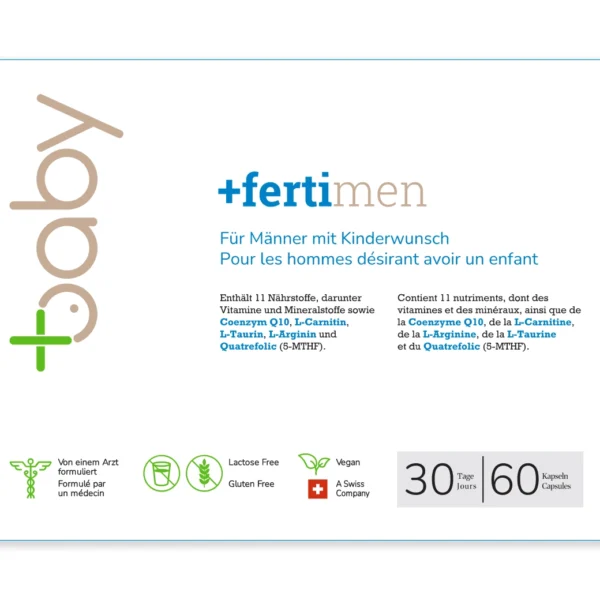
As Switzerland’s Swiss Vegan Fertility Leader, Plusbaby’s +fertimen was formulated with Swiss medical expertise. It contains 11 key nutrients, including L-Carnitine, L-Arginine, Taurine, Coenzyme Q10 (ubiquinol form), Zinc, Selenium and Quatrefolic® (bioactive folate). It is designed to support sperm motility and count.
+fertimen is 100% vegan, free from the 14 major allergens, contains no artificial colours, fillers or preservatives, and is produced to GMP and ISO standards. It offers a clean, high-bioavailability option for men looking for evidence-based nutritional support alongside lifestyle changes.
The Problem: Nadia and Marc, a couple from Lausanne, had been trying to conceive for 14 months. Nadia went through cycle tracking, blood work and an ultrasound — all normal. Frustrated, her gynaecologist finally suggested Marc also get a semen analysis.
The Turning Point: The results showed a low sperm count with reduced motility. Marc admitted he rarely thought about his own fertility; he had assumed it “wasn’t his side of the problem.”
The Path Forward: Their doctor recommended cutting back on alcohol, reducing sauna visits, improving sleep, and adding targeted nutrients to support sperm quality. Three months later — the time it takes for new sperm to fully develop — his numbers had noticeably improved.
Expert Insight: “Male factor infertility contributes to nearly half of all cases, yet men are often tested last,” note fertility specialists reviewing cases like this. “A simple test early on can save couples months of uncertainty.”
Nutrients such as L-Carnitine, Coenzyme Q10, Zinc and Selenium are commonly included in the best sperm motility supplements in Switzerland, as they help support healthy sperm movement, energy production and overall sperm quality.
Diet and lifestyle changes are a strong starting point, but many men still fall short on the specific nutrients sperm production depends on — especially when meals are irregular or stress levels are high.
This is where targeted nutrition can help close the gap. Plusbaby, Switzerland’s Swiss Vegan Fertility Leader, was built around this idea: making it easier for couples to get consistent, high-quality nutritional support without guesswork.
+fertimen was formulated with Swiss medical expertise and combines nutrients such as L-Carnitine, L-Arginine, Taurine and Coenzyme Q10 — the same categories studied for their role in sperm motility and count — into one simple daily routine.
It is 100% vegan, free from the 14 major allergens, contains no artificial colours, fillers or preservatives, and is manufactured to GMP and ISO standards. It fits naturally alongside the lifestyle steps outlined in this guide.
Your body, your timeline, your support plan.
Start with +fertimen or explore everything Plusbaby offers — subscription plans available so you never miss a step.
Question: Does low sperm count mean infertility?
Answer: Not necessarily. Many men with low counts still conceive naturally, especially with lifestyle and nutritional support.
Question: How long does it take to improve sperm count naturally?
Answer: Most changes take about three months, matching the sperm production cycle.
Question: Can supplements really help?
Answer: Targeted nutrients can support sperm quality, especially when combined with healthy habits. If you are comparing daily nutritional support options, you may also find our guide to male fertility vitamins helpful when choosing the right supplement for your fertility journey.
Question: Is low sperm count common in Switzerland?
Answer: Yes. Like much of the world, lifestyle and environmental factors make it an increasingly recognised concern among Swiss couples. Population studies of young Swiss men have shown that a significant proportion have at least one suboptimal semen parameter.
Medical Disclaimer
This article is intended for general information and does not replace professional medical advice, diagnosis or treatment. Always consult your family doctor, gynaecologist, urologist or andrologist for personalised guidance