10% off for life with subscription + Free Shipping 


10% off for life with subscription + Free Shipping



The moment a couple decides to start a family is one of the most hopeful in a person’s life. What comes next, the charting, the waiting, the uncertainty, is less discussed.
What is almost never discussed is what needs to happen inside your body before you even begin.
As a Swiss Vegan Fertility Leader, Plusbaby believes fertility preparation starts long before a positive pregnancy test. The right nutritional foundation can help support reproductive wellness for both women and men during the conception journey.
This guide changes that.
Sarah and James had been trying to conceive for five months. They were tracking ovulation, eating well, and had even cut back on alcohol. On paper, they were doing everything right. But what their GP hadn’t mentioned, and what most couples never find out until it’s too late, was something fundamental about how the human reproductive system actually works.
Egg development begins 90 days before ovulation. Sperm production takes around 74 days. The nutritional environment inside your body right now is directly shaping the reproductive cells that will matter months from now. Waiting until you see a positive pregnancy test to start thinking about nutrition isn’t just late, it may mean you’ve already missed the most critical developmental window.
“My gynaecologist showed me my blood results and said my Vitamin D was critically low and my folate wasn’t where it should be. I had no idea these things even affected fertility.”
— Hannah B., Plusbaby customer
Hannah’s story is not an outlier. It’s the most common thing fertility specialists hear in their consulting rooms every single day. Millions of women take prenatal vitamins after a positive test, but by then, the earliest and arguably most important phase of fetal development has already begun without nutritional support.
This is why healthcare professionals now overwhelmingly recommend starting prenatal vitamins before pregnancy, ideally 2 to 3 months before you begin trying. And for good reason.
Important: This guide is for informational purposes only and does not replace personalised medical advice. Always consult a qualified healthcare professional before beginning any supplement routine.
When couples begin researching preconception vitamins, they often assume that any standard multivitamin will do the job. The reality is more nuanced, and more important.
Reproductive health is directly influenced by specific micronutrients that regulate hormonal function, protect cells from oxidative damage, support egg quality, and enable healthy sperm production. A general supermarket multivitamin rarely contains these nutrients at clinically meaningful doses, and almost never in the right forms.
Here is what the research consistently shows:
These are not marginal benefits. They are the nutritional foundations that trying to conceive vitamins should be built upon, not an afterthought.
If you want to understand how Myo-Inositol supports ovulation, hormonal balance, and fertility wellness, read our complete guide on what Myo-Inositol actually is and how it works.
The fertility supplement market is crowded, and the quality is wildly inconsistent. Choosing the right pre pregnancy multivitamin requires knowing exactly what separates a formula that genuinely works from one that simply looks good on a shelf.
What a genuinely effective formula includes
Red flags that signal a product to avoid
The best multivitamin for fertility is never the flashiest product on the shelf. It is the one whose formula stands up to scrutiny: transparent, bioavailable, dosed correctly, and certified clean.
Taking the right supplement is only part of the journey. Learn when to start fertility supplements before trying to conceive for the best results.
The table below outlines the most clinically important nutrients for reproductive health, who needs them, and why they matter:
| Nutrient | Women | Men | Why it matters |
|---|---|---|---|
| Quatrefolic® (active folate) | Essential | Beneficial | Bypasses MTHFR — absorbed instantly, unlike synthetic folic acid |
| Myo-Inositol | Essential* | — | Restores ovulation & hormonal balance; first-line for PCOS |
| Vitamin D3 (algae-derived) | Essential | Important | Regulates implantation hormones; deficiency widespread in Europe |
| Iron (bisglycinate) | Essential | — | Supports ovulation; chelated form avoids digestive side effects |
| CoQ10 | Beneficial | Beneficial | Protects egg & sperm DNA from oxidative damage |
| Zinc | Important | Essential | Drives sperm production, testosterone balance, egg maturation |
| L-Carnitine | — | Essential | Fuels sperm motility at the cellular level |
| Selenium | Beneficial | Essential | Shields sperm DNA from free-radical damage |
| Omega-3 DHA | Important | Important | Underpins embryo development & hormone signalling |
| Vitamin B12 | Important | Important | Enables healthy cell division from the very first days |
* Essential at therapeutic dose for women with PCOS, irregular cycles, or insulin sensitivity concerns. Standard multivitamin doses are insufficient — look specifically for formulas that list Myo-Inositol as a featured ingredient at 2,000 mg or above.
💡 On folic acid vs. Quatrefolic®: When you see “folic acid for conception” on a label, look closer. Active Quatrefolic® (5-MTHF) is immediately bioavailable regardless of your genetic profile.
Standard synthetic folic acid requires conversion — a step that fails in up to 40% of people. Always choose the active form.
You can also compare active folate with standard folic acid in our detailed article on why Quatrefolic® (5-MTHF) matters in prenatal vitamins.
Ready to support your fertility naturally? You now know what separates a high-quality fertility supplement from a shelf-filler. Take the next step and give your body the nutritional foundation it deserves.
After reviewing Hannah’s blood work, her specialist, Dr. Fischer-Stoca, a Swiss gynaecologist and the formulator behind Plusbaby’s range, recommended a targeted approach rather than a generic prenatal supplement for TTC off the shelf.
Plusfertiwomen Inositol — Best Overall for Women
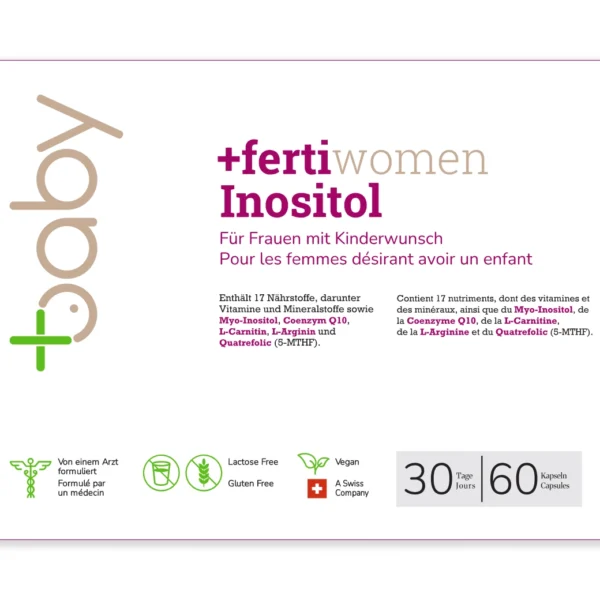
Plusfertiwomen Inositol is Plusbaby’s flagship vitamin for women trying to get pregnant. It combines the full spectrum of evidence-based nutrients women most commonly need before conception, at doses that actually matter.
The formula includes: Myo-Inositol at therapeutic levels for hormonal balance and ovarian support; Quatrefolic® (methylated folate); algae-derived Vitamin D3; bisglycinate iron; CoQ10; Selenium; and Zinc. No artificial additives. No fillers. No compromises.
It is particularly effective for women with PCOS, irregular cycles, or hormonal imbalance, conditions where Myo-Inositol at the right dose can make a meaningful clinical difference. No additional Inositol supplement is needed alongside it.
“My gynaecologist told me it contains everything I need and nothing else. That was exactly the reassurance I was looking for.”
— Hannah B., verified Plusbaby customer
Best for: Regular and irregular cycles, PCOS, hormonal imbalance, women looking for a clean and complete pre pregnancy multivitamin
Formula: 100% vegan, GMP & ISO certified, no artificial additives or preservatives
Price: CHF 55.90 at plusbaby.ch
Plusfertimen — Best for Men Trying to Conceive
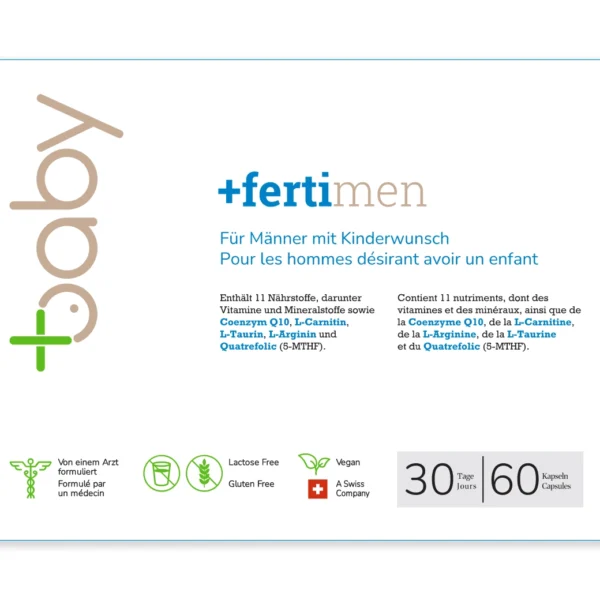
Because nearly half of all fertility challenges involve male reproductive health, Plusbaby developed Plusfertimen as a targeted prenatal supplement for TTC specifically for men, something that is still rare and badly needed in the supplement market.
Plusfertimen contains 11 key nutrients: L-Carnitine (for sperm motility and energy), L-Arginine (for blood flow and production), Zinc, Selenium, Quatrefolic® folate, Vitamin D3, Vitamin B12, and CoQ10. Together, they support sperm count, motility, and DNA integrity, the three pillars of male reproductive health.
“Simple to take every morning and much more targeted than regular multivitamins. I actually feel like I’m doing something useful for the first time.”
— Christian R., verified Plusbaby customer
Best for: Men supporting sperm quality, motility, count, and overall reproductive health
Formula: 100% vegan, doctor-formulated, no artificial additives
Price: CHF 55.90 at plusbaby.ch
Why Supplementing Together Changes Everything
When both partners supplement simultaneously, research shows that the combined effect on reproductive outcomes is greater than either partner supplementing alone. Fertility is not a solo journey, and best prenatals for trying to conceive should reflect that.
The recommended Plusbaby couples stack:
For women who become pregnant and want to continue seamless nutritional support, Plusbaby Plusmum, containing 17 nutrients including bisglycinate iron and DHA, is formulated to begin before conception and continue safely through breastfeeding. No switch needed.
Finding the right supplement is only part of the journey. Our guide on where to buy fertility supplements in Switzerland explains where Swiss couples can find high-quality fertility and prenatal products.
Most fertility specialists recommend beginning vitamins to take before conception at least 2 to 3 months before trying. Here is a simple pre-conception roadmap:
Consistency over these months is what matters. Trying to conceive, vitamins work best when taken daily across the full egg and sperm development cycle, not started the week before you begin trying.
Fertility specialists offer consistent guidance to patients before they start any supplement routine. Their recommendations go beyond simply choosing a product:
Always consult a qualified healthcare professional or fertility specialist before beginning any prenatal vitamin, fertility supplement, or nutritional routine.
Trying to conceive is not only about timing. It is about preparing your body and your partner’s — with the right nutritional foundation before pregnancy even begins. The right preconception vitamins help support hormonal balance, protect egg and sperm quality, and give you the best possible start.
As a Swiss Vegan Fertility Leader, Plusbaby is committed to supporting couples through every stage of the TTC journey with doctor-formulated, clinically considered fertility and prenatal nutrition. From Plusfertiwomen Inositol and Plusfertimen to the seamless transition into Plusmum prenatal support, every formula is developed with clean ingredients, meaningful nutrient levels, and no unnecessary additives.
Question: What are the best multivitamins for trying to conceive?
Answer: The best fertility supplements usually contain folate, iron, vitamin D3, omega-3s, zinc, and antioxidants that support reproductive health for both women and men.
Question: When should I start taking prenatal vitamins before pregnancy?
Answer: Most specialists recommend starting prenatal vitamins or fertility supplements at least 2–3 months before trying to conceive to help build healthy nutrient stores.
Question: What vitamins are important before conception?
Answer: Some of the most important vitamins to take before conception include folate, vitamin D3, iron, choline, zinc, selenium, and omega-3 DHA.
Question: Do men also need fertility supplements?
Answer: Yes. Male fertility plays a major role in conception. Nutrients like Zinc, Selenium, CoQ10, and L-Carnitine may help support sperm health and motility.
Question: Can I take fertility supplements and prenatal vitamins together?
Answer: In many cases, yes. Some women use fertility-focused supplements during the TTC phase and later transition to prenatal formulas during early pregnancy. Always consult your healthcare professional before combining supplements.