10% off for life with subscription + Free Shipping 


10% off for life with subscription + Free Shipping


Written by the Magali Russell
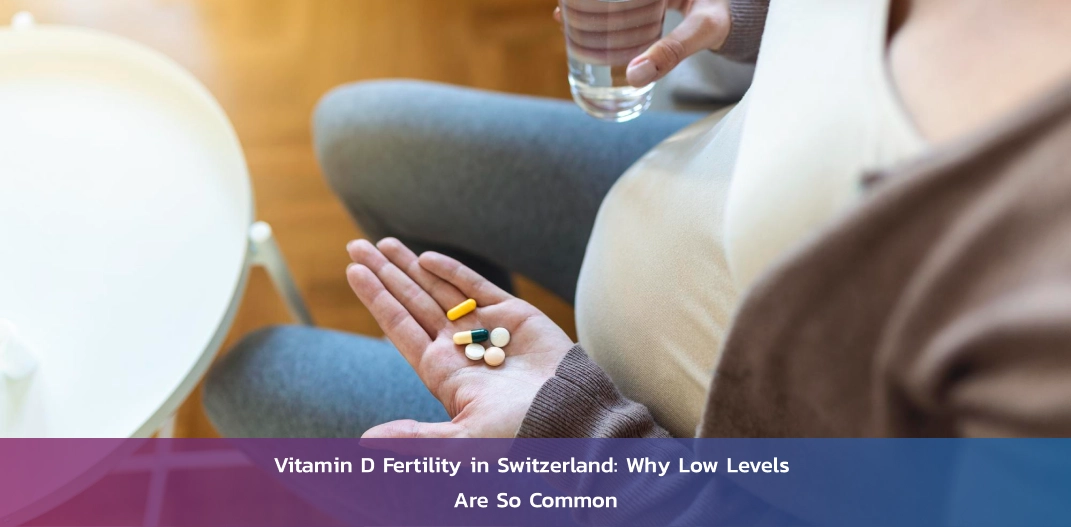
Clara’s blood test showed a number she did not expect: 31 nmol/L. She is 34, works as an architect in St. Gallen and hikes most weekends. She and her partner Luca are trying to have their first baby. Yet her result is very common in Switzerland.
This guide explains vitamin D fertility research in simple terms. As the Swiss Vegan Fertility Leader, Plusbaby wants couples to have clear and honest information before they choose any supplement.
Table of Contents
ToggleThe data on vitamin D deficiency in Switzerland is clear. The Federal Commission for Nutrition (FCN) estimates that about 50% of the Swiss population has low levels.
A study of pregnant women in Bern found that 73% had levels below 50 nmol/L. For many Swiss women, a low result is the norm.
At Swiss latitudes, useful UVB light is available for only part of the year. Indoor work and sunscreen reduce it further, so many people never build full stores.
Few foods contain much vitamin D. Even the best foods to eat when trying to conceive provide only small amounts. Food fortification is limited in Switzerland. On a vegan diet, natural sources are almost absent.
Some factors lower levels further:
Many couples begin trying without knowing their vitamin D level. Women need vitamin D for ovulation and pregnancy. Men need it for sperm health. So vitamin D conception planning is one reason why both partners should take fertility supplements.
Low vitamin D can cause tiredness, low mood or muscle aches. Many people feel fine, like Clara. A blood test matters more than symptoms.
The test measures 25 hydroxyvitamin D, the main storage form of vitamin D in your blood.
Vitamin D blood levels explained
| 25(OH)D level (nmol/L) | 25(OH)D level (ng/mL) | What it usually means |
| Below 25 | Below 10 | Severe deficiency |
| 25 to 49 | 10 to 19 | Deficiency |
| 50 to 74 | 20 to 29 | Adequate for most adults |
| 75 and above | 30 and above | Target level used by many doctors |
| Above 250 | Above 100 | Too high, with a risk of side effects |
Ask your gynaecologist or GP as part of a 3 month preconception plan for couples if you plan a pregnancy, especially with a risk factor above. Basic insurance in Switzerland usually covers the test when your doctor gives a medical reason.
Luca asked his GP for the same test. His level was also low.
Preparing for pregnancy as a couple?
Vitamin D matters for both partners. +fertiwomen Inositol and +fertimen are Swiss doctor formulated and 100% vegan.
Each contains algae vitamin D3 at a daily maintenance dose, plus Quatrefolic® active folate.
Studies link adequate vitamin D with healthy ovarian function and a healthy endometrium. A 2018 meta analysis in Human Reproduction looked at women in IVF and ICSI. Women with adequate vitamin D had higher live birth rates than women with deficiency. This is an association, not proof of cause.
Vitamin D receptors are also present in sperm cells. A Danish study found that men with very low vitamin D had fewer motile sperm. This is why many sperm motility supplements in Switzerland include vitamin D3.
Vitamin D is only one factor. See our guide on low sperm count causes, tests and natural solutions.
Supplement trials on pregnancy rates show mixed results. Vitamin D cannot replace a medical assessment. Vitamin D fertility research supports adequate levels. It does not support very high doses.
Most vitamin D3 supplements use lanolin, a fat from sheep’s wool. It is not suitable for a vegan diet.
Certain microalgae produce vitamin D3 naturally. It is extracted and purified, so the result is fully plant based. This makes algae vitamin D3 fertility support possible for vegan couples.
Algae D3 and lanolin D3 are the same molecule, cholecalciferol. Only the source is different. This matters for couples who look for vegan fertility vitamins in Switzerland.
Clara eats mostly plant based, so she chose an algae vitamin D3 fertility option.
All three Plusbaby formulas are Swiss doctor formulated, vegan and made under GMP and ISO standards. They use high bioavailability forms such as Quatrefolic® folate and bisglycinate iron.
Vitamin D3 in Plusbaby formulas
| Product | Vitamin D3 per daily dose (2 capsules) | Source | Life stage |
| +fertiwomen Inositol | 5 µg (200 IU) | Algae | Preconception, women |
| +fertimen | 5 µg (200 IU) | Algae | Preconception, men |
| +mum | 25 µg (1,000 IU) | Algae | Pregnancy and breastfeeding |
The FCN recommends 600 IU (15 µg) per day for adults, including pregnant women. +fertiwomen Inositol and +fertimen provide 200 IU. The rest can come from sunlight, food or a separate supplement your doctor advises. +mum provides 1,000 IU.
This is well below the upper safe limit of 4,000 IU per day for adults. If you compare prenatal vitamins in Switzerland, always check the vitamin D dose on the label.
Vitamin D is fat soluble, so very high intake over time can raise calcium levels too much. This is why many women fertility vitamins in Switzerland use maintenance doses.
Count every source and tell your doctor what you take.
Clara’s level was 31 nmol/L. Her gynaecologist prescribed a higher dose for a limited period. Do not start high doses without medical advice. Vitamin D deficiency Switzerland guidelines recommend treatment under medical supervision.
Women with PCOS often have lower vitamin D levels.
Read our comparison of myo inositol vs metformin for PCOS. Swiss clinics may test it before IVF or ICSI.
A second test after 8 to 12 weeks shows if the plan works. Clara’s second test showed 68 nmol/L. She then continued with +fertiwomen Inositol for maintenance, and Luca took +fertimen.
Clara’s story is common. Limited sunlight, indoor lifestyles, and few food sources explain why vitamin D deficiency Switzerland figures stay high. A simple blood test gives a clear answer, and your doctor can choose the right dose. Vitamin D fertility research supports adequate levels for both partners.
It does not promise a pregnancy. Good vitamin D conception planning starts with a test, not a guess.
As the Swiss Vegan Fertility Leader, Plusbaby supports this step with vegan formulas and honest dose information.
Your next step: test, then support
Ask your doctor for a 25(OH)D test before you plan your supplements.
For daily maintenance, +fertiwomen Inositol and +fertimen provide algae vitamin D3 with Quatrefolic® active folate for both partners.
After a positive pregnancy test, +mum continues with 1,000 IU of algae vitamin D3 and gentle bisglycinate iron.
Explore +fertiwomen Inositol | Explore +fertimen | Explore +mum
Question: Does low vitamin D stop you from getting pregnant?
Answer: Low vitamin D is rarely the only cause of difficulty getting pregnant. Studies link low levels with lower live birth rates in IVF and ICSI. However, many factors affect fertility, including age, ovulation, sperm quality and thyroid health. A full assessment of both partners by your doctor comes first. Correcting a low level is then one useful step.
Question: Should my partner also take vitamin D?
Answer: Yes, if his level is low. Men in Switzerland have the same risk factors as women. Vitamin D plays a role in sperm motility and testosterone. Sperm take about 74 days to develop, so it is best to start early. Vitamin D conception planning works best when both partners test their levels.
Question: Is algae vitamin D3 good for fertility?
Answer: Yes. Algae vitamin D3 is cholecalciferol, the same molecule as lanolin vitamin D3. Only the source is different. This makes algae vitamin D3 fertility support a suitable choice for vegan and vegetarian couples.
Question: Can I take +fertiwomen Inositol with a separate vitamin D supplement?
Answer: Yes, if your doctor recommends it. +fertiwomen Inositol provides 200 IU per day. Add this to any vitamin D drops or tablets you take. Share your full list with your doctor to keep your intake safe.
Question: Is sunlight enough to keep my vitamin D level normal?
Answer: For some people, regular sunlight is enough for part of the year. People with risk factors often need a supplement all year. This includes people with darker skin, indoor work or a vegan diet. A blood test is the only way to know your own level.
Note: Plusbaby resources provide general information. They do not replace professional medical advice, diagnosis or treatment.
Table of Contents
ToggleAcheter les produits de cet article

I am Magali Russell, the founder of Plusbaby. With over 15 years of experience in research and development, I created and led a preclinical research organisation that conducted rigorous scientific studies on numerous products.The moving stories of women and couples struggling with infertility left a lasting impression on me. This is how I found my calling in life: helping others become parents by offering them genuine support.
Convinced of the benefits of natural products, I created Plusbaby: vegan dietary supplements, developed in Switzerland, combining proven science and pure, premium, additive-free ingredients to boost fertility naturally.
Continue reading